
 USD
USD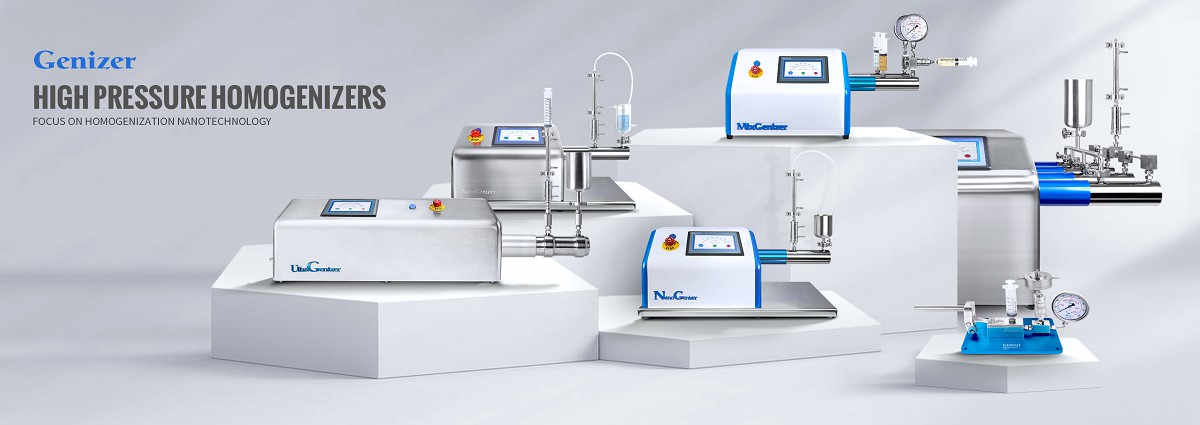 Choosing a Homogenizer for Liquid Formulations
 Choosing a Homogenizer for Liquid Formulations
Understanding Product Characteristics
When creating liquid formulations, achieving uniform dispersion of active ingredients is essential for product effectiveness and stability. Before selecting a homogenizer, consider your product’s characteristics, including viscosity, particle size, and required processing pressure.-
Viscosity: Higher viscosity requires more force for effective homogenization.
-
Particle Size: Smaller particles need higher pressure to achieve uniformity.
-
Required Pressure: Different formulations may require varying pressures to achieve consistent dispersion.
Types of Homogenizers
Rotor-Stator Homogenizers
Rotor-stator homogenizers are commonly used for low- to medium-viscosity products. They provide cost-effective and efficient mixing for small to moderate volumes.Advantages: Easy to operate, low cost
Limitations: Not suitable for high-viscosity or large-volume formulations
Ultrasonic Homogenizers
Ultrasonic homogenizers use high-frequency sound waves to break down particles. They are ideal for formulations sensitive to heat.Advantages: Efficient for small samples, minimal heat generation
Limitations: Not suitable for large-scale production
High-Pressure Homogenizers (HPH)
High-pressure homogenizers are suitable for high-viscosity products and provide consistent particle size reduction. Formulations pass through high-pressure chambers, experiencing shear, impact, and turbulence, resulting in uniform dispersion.Advantages: Handles high-viscosity samples, consistent results
Limitations: Higher cost, requires regular maintenance
Factors to Consider When Choosing a Homogenizer
Selecting the right homogenizer depends on multiple factors:
-
Sample Volume: Ensure your lab or facility can handle the required throughput.
-
Equipment Type: Choose the type that matches viscosity and particle size requirements.
-
Budget and Maintenance: Consider equipment cost, ease of operation, and maintenance requirements.
These considerations help ensure that your formulation process is efficient and reproducible.
NanoGenizer: A High-Pressure Homogenizer Option

For high-pressure homogenization, systems such as the NanoGenizer provide efficient particle size reduction and uniform dispersion.
-
Accommodates a wide range of sample volumes
-
Compact design suitable for laboratory-scale studies
-
Easy-to-use interface for precise control
By selecting systems like the NanoGenizer, formulators can achieve consistent and reliable results across various liquid formulations.
 949-932-0294 Los Angeles
  Nano@Genizer.com