
 USD
2026 Microjet Application Guide: Graphene & Carbon Nanotubes
2026 Microjet Application Guide: Graphene & Carbon Nanotubes
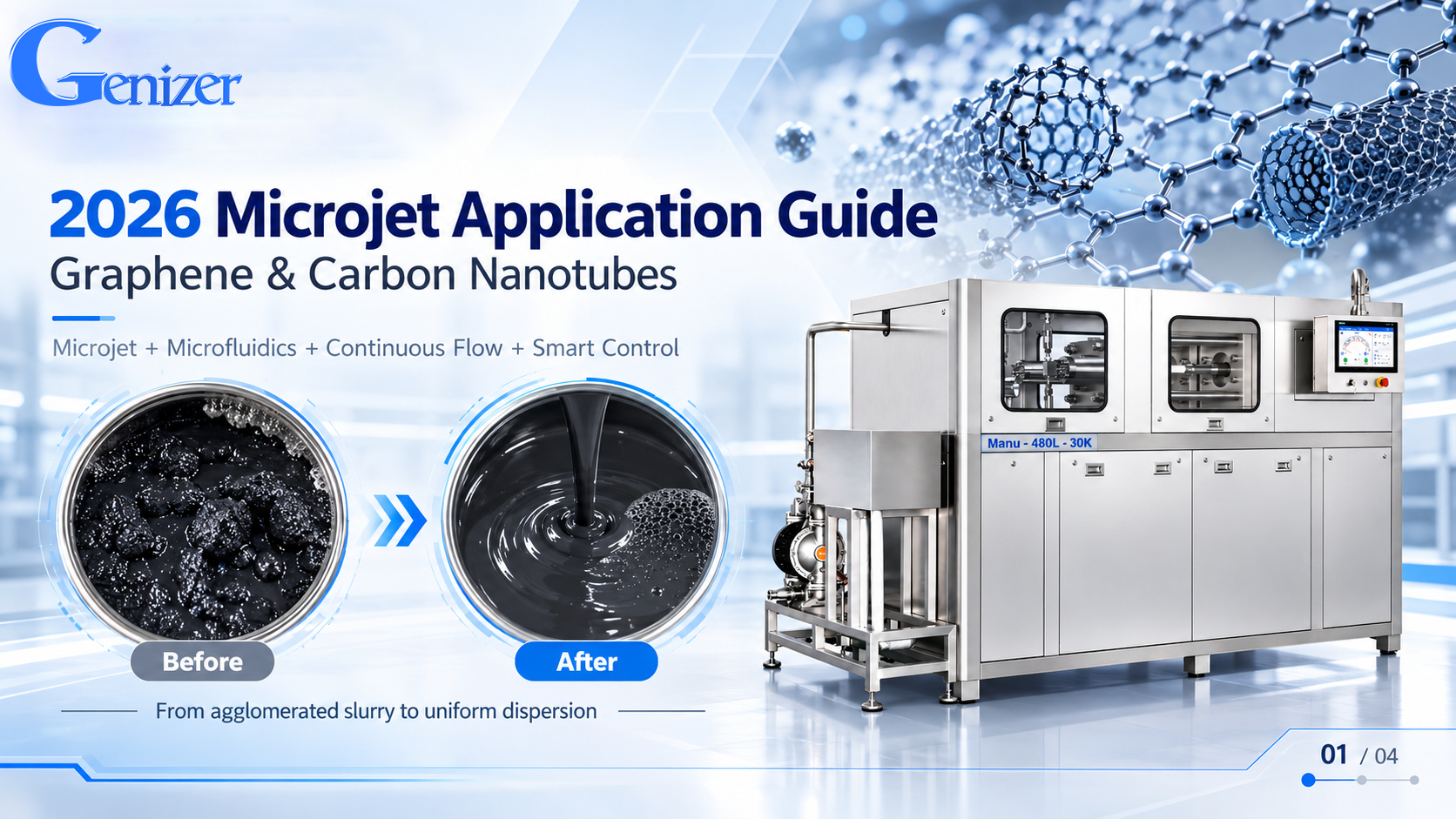
Microjet processing can support the preparation of carbon nanomaterial dispersions by driving a liquid suspension through engineered interaction chambers at elevated pressure. The resulting flow conditions can generate shear, impact, and cavitation. The appropriate operating window depends on the starting material, liquid phase, additives, concentration, and desired product properties. For this reason, graphite exfoliation, graphene deagglomeration, and carbon nanotube (CNT) debundling should be treated as distinct process-development tasks.
Three Genizer platforms support different throughput needs. PilotGenizer is designed for pilot-scale trials at approximately 20–60 L/h, with model-dependent pressure capability from 15,000 to 45,000 psi and minimum sample volumes of about 100–200 mL. ProdGenizer covers approximately 100–300 L/h, with model-dependent pressure capability from 5,000 to 30,000 psi and minimum sample volumes of about 300–1,000 mL. ManuGenizer supports industrial processing at approximately 120–1,000 L/h, with customized configurations up to 2,000 L/h and model-dependent minimum sample volumes of 5–15 L. Confirm the selected model’s specifications before defining a process.
Three Genizer platforms support different throughput needs. PilotGenizer is designed for pilot-scale trials at approximately 20–60 L/h, with model-dependent pressure capability from 15,000 to 45,000 psi and minimum sample volumes of about 100–200 mL. ProdGenizer covers approximately 100–300 L/h, with model-dependent pressure capability from 5,000 to 30,000 psi and minimum sample volumes of about 300–1,000 mL. ManuGenizer supports industrial processing at approximately 120–1,000 L/h, with customized configurations up to 2,000 L/h and model-dependent minimum sample volumes of 5–15 L. Confirm the selected model’s specifications before defining a process.
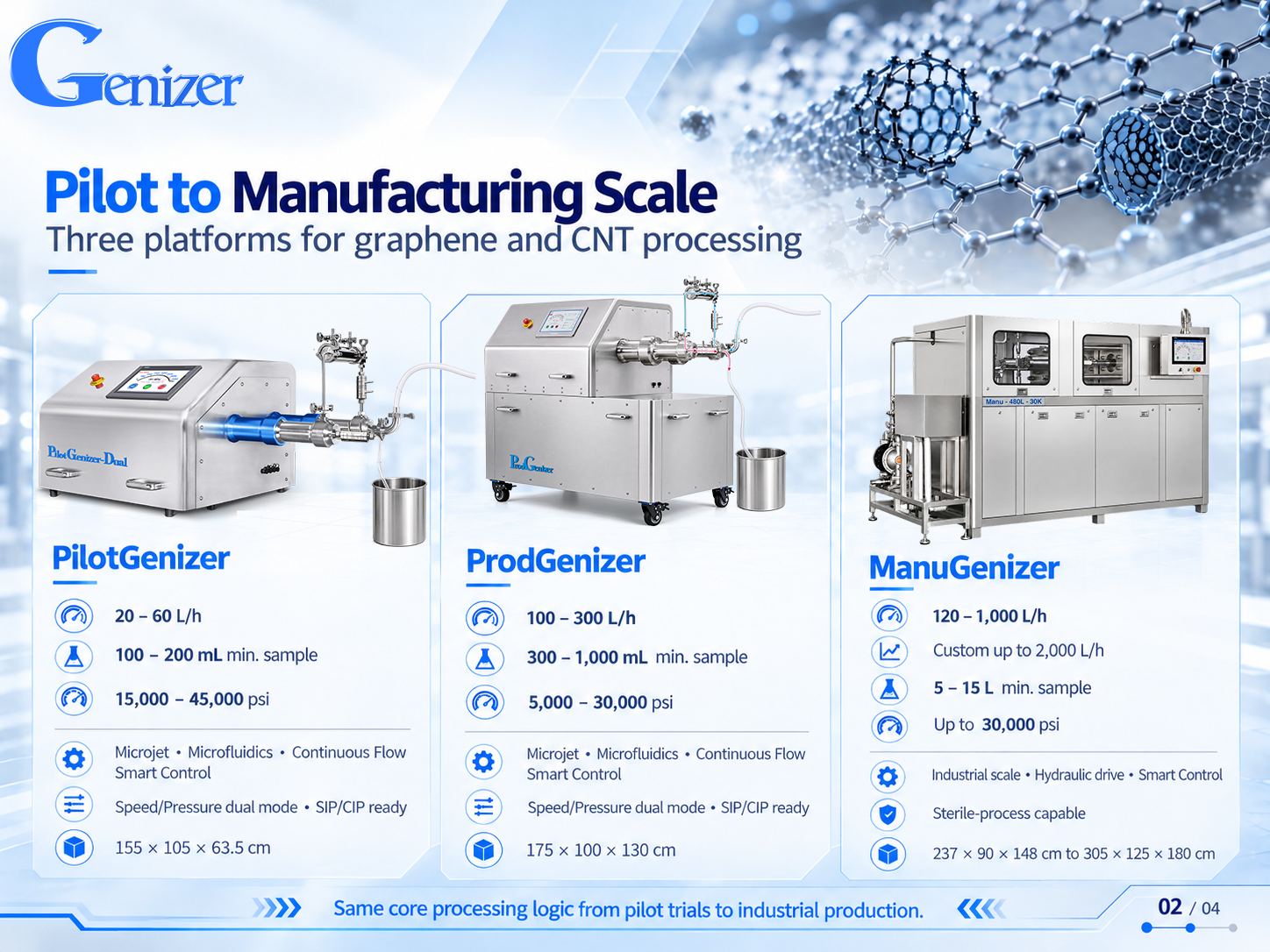
The platforms combine microjet processing, microfluidic interaction chambers, continuous-flow operation, and smart-control functions. PilotGenizer and ProdGenizer offer speed and pressure operating modes and can be configured for SIP/CIP requirements. ManuGenizer uses hydraulic drive and smart control for industrial-scale operation. Actual sanitary design and process suitability should be confirmed against the requirements of the intended application.
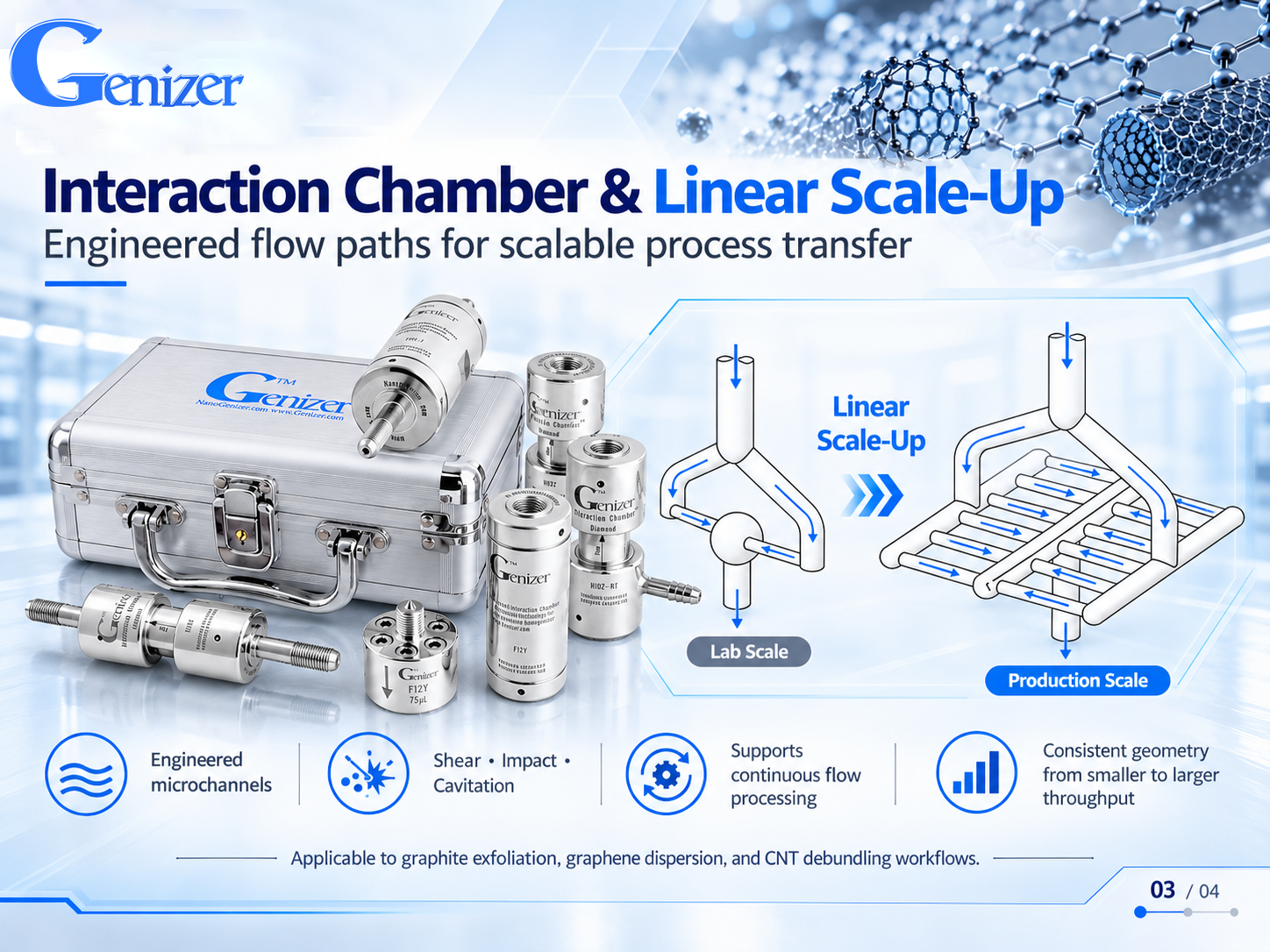
Interaction chamber geometry is an important process variable. Linear scale-up should be based on process-relevant parameters and verification trials rather than throughput alone. Evaluate pressure, flow rate, pass count, temperature, formulation, and material characterization when transferring a workflow from smaller trials to larger systems.
Three application categories deserve separate evaluation. First, liquid-phase exfoliation starts with natural or expanded graphite and aims to produce few-layer graphene dispersions. Second, graphene nanoplatelets, graphene oxide (GO), or reduced graphene oxide (rGO) may require deagglomeration and dispersion for inks, coatings, or slurries. Third, single-wall or multi-wall CNTs may require debundling and dispersion for conductive slurries and composites. The resulting structure, dispersion quality, and functional performance should be measured for each material; no single outcome should be assumed across all three workflows.
Three application categories deserve separate evaluation. First, liquid-phase exfoliation starts with natural or expanded graphite and aims to produce few-layer graphene dispersions. Second, graphene nanoplatelets, graphene oxide (GO), or reduced graphene oxide (rGO) may require deagglomeration and dispersion for inks, coatings, or slurries. Third, single-wall or multi-wall CNTs may require debundling and dispersion for conductive slurries and composites. The resulting structure, dispersion quality, and functional performance should be measured for each material; no single outcome should be assumed across all three workflows.
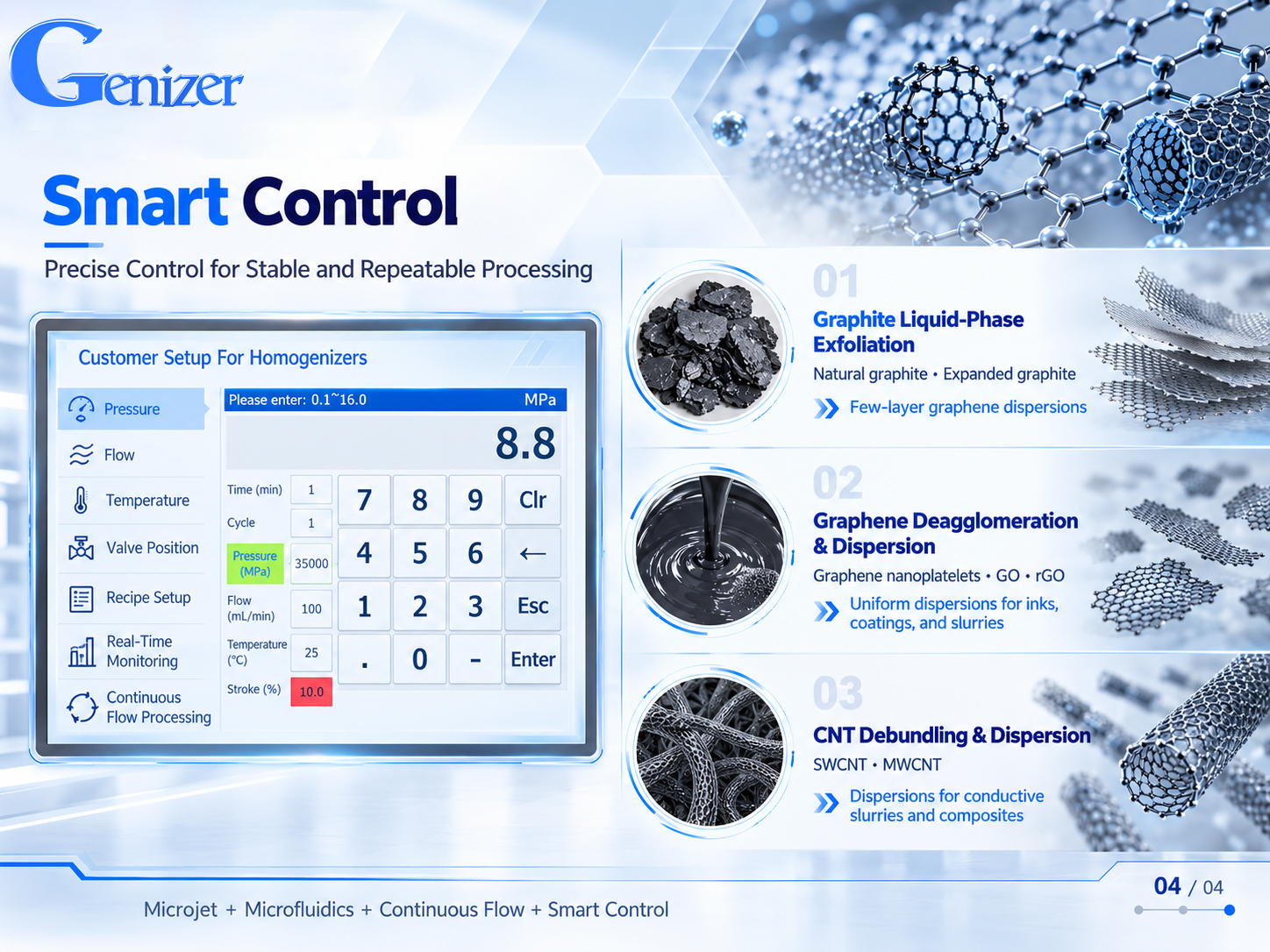
Genizer’s PilotGenizer, ProdGenizer, and ManuGenizer systems provide options for evaluating these workflows from pilot trials through industrial throughput. A practical development plan combines material-specific testing, controlled operating conditions, and documented scale-up criteria.
 949-932-0294 Los Angeles
 Nano@Genizer.com